


AdminSheet Pro is a Google Sheets add-on that helps Google Workspace administrators manage users, groups, members and aliases in bulk without relying on command-line tools. When we crossed 102,000 installs on the Google Workspace Marketplace within 45 days of going live, it was a big moment for our small team. It was exciting, humbling, and slightly unreal. But it also forced us to reflect on what actually got us there.
The honest answer is simple: it was not magic. A lot of it came from doing things that do not scale, borrowing from the classic advice by Y Combinator co-founder Paul Graham: in the early days, founders often have to do the manual, uncomfortable, repetitive work that cannot yet be automated.
This article is not a victory lap. Installs are important, but installs are not the same as active users, loyal customers, or long-term revenue. We are very aware of that. However, crossing 102,000 installs gave us enough data and experience to pause and share some of the things we did, what worked, what did not work as expected, and what we are still learning.
Our two-lane growth strategy
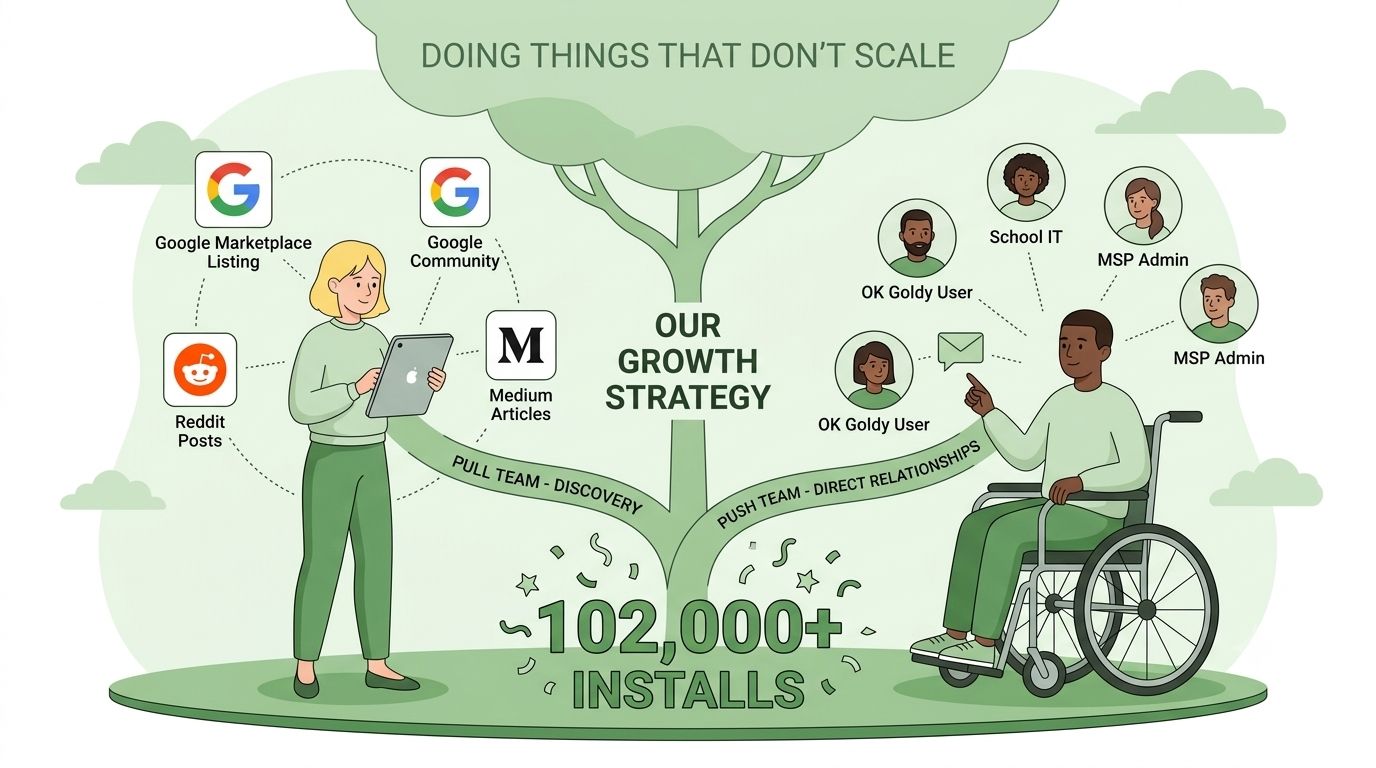
From the beginning, we divided our early growth work into two broad categories. We split our small team into two focused operational branches: the Pull Team and the Push Team.
The Pull Team focused on activities that made it easier for people to find us. This included our website, articles, documentation, Google Workspace Marketplace listing, Medium posts, Reddit posts, Google Community posts, and other places where Google Workspace administrators might search for solutions. Their goal was simple: when an admin searched for a solution to their problem, we wanted AdminSheet Pro to be available to be found.
The Push Team focused on finding the people who were already feeling the pain. These included Google Workspace admins, school IT managers, Managed Service Providers, Google Partners, Ok Goldy users, and people asking questions about bulk user, group, member or alias management.
This gave us structure. It meant we were not just randomly posting online and hoping someone would notice us. We were trying to build a repeatable system, even though the early work itself was very manual.
1. We used AI to listen, but humans built the relationships
One of the first things we did was create AI-assisted monitoring workflows. Internally, we thought of them as scouts. Their job was not to sell. Their job was to help us discover relevant conversations, questions and pain points across different online spaces. We wanted to know where people were talking about Google Workspace admin problems, Ok Goldy alternatives, GAM challenges, bulk user management, group clean-up, aliases and other related issues.
This helped us find possible conversations faster. But the important lesson was that AI could only help us listen. It could not build the relationship for us. After identifying a relevant post or comment, the rest of the work was manual. We had to visit the source, understand the context, read what the person was really asking, and decide whether we had anything useful to contribute.
Sometimes the best response was not to mention AdminSheet Pro at all. Sometimes it was simply to explain a possible solution, share a lesson we had learnt, or point someone towards a helpful resource. In some cases, where it felt appropriate, we followed up privately to offer additional help. The lesson was clear: AI can help you find the room, but you still have to enter it like a human being. Early-stage marketing is not only about pushing a product. It is about understanding the people who may eventually trust the product.
2. Search is no longer just about your own website
We believe every software product needs a proper website. Your website should be the main home of your product. It should explain what the product does, who it is for, how pricing works, how to get support, and why users should trust you. But we also learnt that discovery does not happen only on your website.
People now find answers in many places. They search Google. They read Reddit threads. They ask questions in communities. They skim Medium articles. They compare Marketplace listings. They look for reviews. They follow discussions. They may even see AI-generated summaries before they ever visit your website. So, while our website remained the hub, we started treating other platforms as discovery surfaces.
We published and adapted content across a small number of places, including our own website, Medium, Reddit, Google Community spaces and our Google Workspace Marketplace listing. The keyword here is “adapted”. We did not simply copy and paste the same thing everywhere. A website article can be detailed and structured. A Medium article can be more reflective. A Reddit post must be conversational and useful. A community response must focus on the problem being discussed, not on self-promotion.
This process was tedious. It was manual. It took time. That is why we deliberately limited ourselves to a few platforms. At this stage, we did not want to post everywhere. We wanted to post in a manageable number of places and then watch what happened. We are still analysing which channels are performing well. Over time, we expect to drop weaker channels and spend more effort on the ones that bring the right kind of users. The lesson here is simple: your website should be the hub, but your users may discover you elsewhere.
3. Google Alerts helped us build a listening habit
We also set up Google Alerts for our own product name and for the names of alternative tools. The idea was simple. If someone mentioned AdminSheet Pro, Ok Goldy, GAM alternatives, or related admin tools online, we wanted to know. We wanted to be able to join relevant conversations quickly, respond to questions, and understand what people were saying about the space.
This has been useful, but we must be honest: it has not been transformational. Google Alerts did not suddenly flood us with high-quality leads. It did not create a magical stream of customers. It did not replace the harder work of searching, reading, writing and engaging. But it helped us develop an important habit: listening.
For a new product, listening matters. You need to know the language users use to describe their problems. You need to know what they compare you with. You need to know the objections that appear again and again. You need to know which features people care about most. Sometimes the value of a tool is not the number of leads it brings immediately. Sometimes, the value is that it keeps your team alert. That was the case for us.
4. The tale of two Google communities
Communities are powerful because they gather people around shared interests and shared problems. For AdminSheet Pro, communities around Google Workspace administration, Google Partners, schools, MSPs and admin tools are naturally relevant. We were in two Google Chat groups where our target users gathered. One group was made up mainly of Google resellers, while the other was focused on Google Workspace administration.
In both groups, we actively engaged in peer-to-peer conversations. We also reached out manually to some members where we believed the product could be relevant to their work. There were no scripts, no auto-posting, and no mass automation. It was manual, one-to-one, and honestly quite tedious. In the reseller group, our efforts were relatively well received. Only a small percentage of the people we contacted replied, but those who did were mostly warm, curious, or open to trying the tool later. One partner tested AdminSheet Pro, appreciated the experience, wrote a five-star Marketplace review, compared it to a more polished Ok Goldy, and even offered to mention it to other partners and customers.
Encouraged by that response, we attempted a similar direct-message approach in another community. This time, it did not land the same way. Within a few days, the group owner flagged the outbound messages as unauthorised solicitation. We were removed from the group and warned not to continue that approach. We apologised, accepted the feedback, and stopped contacting members from that group. That experience taught us several important lessons.
First, every community has its own culture. What feels acceptable in one space may feel intrusive in another. What works in one group may fail in another. Even if your product is genuinely useful, people do not want to feel that their community has been turned into a lead list.
Second, the better approach is to become genuinely useful in a community before expecting anything from it. Answer questions. Share lessons. Be visible. Respect the rules. Do not rush to private messages. Do not treat members as prospects first. Treat them as people first.
Third, if you get it wrong, do not become defensive. Accept the feedback, apologise where necessary, stop the behaviour, and learn from it. This is especially important for early-stage founders. It is easy to become emotional when you believe deeply in your product. But communities are not obligated to receive your message the way you intended it.
There was another quieter lesson too: non-replies can be emotionally discouraging, but they do not mean the effort was wasted. When you are doing manual outreach, silence can feel personal. You spend time identifying the right person, reading their context, writing a thoughtful message, and then nothing happens. No reply. No acknowledgement. No feedback.
But silence is not always rejection. Some people are busy. Some are not ready. Some see the message and come back later. Some may remember the product name when the problem becomes urgent. Some may never respond, but the process still teaches you which audiences are harder to reach, which messages are too weak, and which channels deserve less time.
In early growth, not every effort produces an immediate visible outcome. Some efforts produce learning. Some produce positioning. Some produce delayed awareness. And sometimes, one reply from the right person makes up for many quiet messages. The lesson was clear: community growth must be earned, and silence should be interpreted carefully, not emotionally.
5. Reviews are digital word of mouth
One of the most important things we learned is that reviews matter. In the B2B space, a product with no reviews can feel risky. For a Google Workspace tool, Marketplace reviews are especially valuable. Administrators are careful people. They want to know that a tool works. They want to see that other users have tried it. They want signals of trust before installing something that requests administrative access.
Reviews help provide that trust. We therefore started asking real users who had used AdminSheet Pro to leave an honest review on the Google Workspace Marketplace. We did not offer rewards. We did not ask for fake praise. We did not ask people to say anything they did not believe. We simply asked them to share their honest experience.
One of the biggest lessons here was timing. Admins are busy people. They are managing users, fixing access problems, handling requests, supporting teams, and often dealing with repetitive work that nobody else sees. But they are also deeply grateful when a software tool saves them hours of manual data entry.
We found that the best moment to ask for feedback was not randomly and not before the user had experienced the product. The best moment was after the value had been delivered. For us, that often meant contacting users who had exhausted their free credits. These were not people who had merely installed the add-on and forgotten about it. They had actually used AdminSheet Pro enough to consume their free operations. In many cases, that meant they had completed a real bulk task and had experienced the value of the tool.
That moment mattered. When a user has just completed a successful bulk operation, saved time, avoided manual work, and seen the tool solve a real problem, they are at their moment of maximum gratitude. Asking for honest feedback at that point feels natural because the value is fresh in their mind.
This helped us achieve a surprisingly strong review-to-active-user response rate for such an early-stage product. But the benefit was not only the reviews. In some cases, asking for a review opened a much deeper conversation. Users told us what they liked. They also told us what confused them, what they expected, what was missing, or what would make the product more useful for their work.
That feedback is now helping us improve the next version of AdminSheet Pro. The lesson is that reviews are not just a marketing asset. They are also a learning channel. And the best review requests are not random. They are timed around real user value.
6. Attribution matters earlier than you think
One surprising lesson came from our second paying customer. With our first paying customer, we knew exactly where the relationship came from. We knew the conversation, the route, the context and the reason they converted. With the second paying customer, we were less certain. We could see the payment. We could see usage signals. We could see the email address and the domain involved. But we could not confidently say whether the customer came from the Marketplace, Google Search, Reddit, one of our articles, a recommendation, or another path entirely.
That bothered us. Not because the sale was bad. It was good news. But because we are trying to build a repeatable growth system. If we do not know where paying users are coming from, we cannot properly understand what is working. That experience reminded us that attribution should not be an afterthought.
We are now improving how we track discovery. We want to ask new users how they found us during onboarding, follow-up and payment. We also want to connect usage, installation and payment data more clearly. The lesson is that early traction is encouraging, but unexplained traction is difficult to repeat. If you are building a product, do not wait until you have many customers before asking where they came from. Start early.
What the 102,000 installs taught us
Crossing 102,000 installs was encouraging, but it did not make us feel like we had arrived. If anything, it made the next challenge clearer. Installs are the beginning of the relationship, not the end of it. The real work is getting users to activate, understand the value, use the tool successfully, give feedback, leave honest reviews, and eventually decide that the product is worth paying for.
That is the stage we are in now. We are grateful for the installs, but we are not blinded by them. We know that a product is not built by numbers alone. It is built by repeated user value. The early growth of AdminSheet Pro has therefore taught us a few simple but important lessons:
- Do the manual work before expecting automation to save you.
- Use AI to support discovery, but do not use it as a replacement for human judgment.
- Publish where users are likely to search, not only where you are comfortable publishing.
- Respect communities before trying to benefit from them.
- Do not let silence discourage you; non-replies can still produce learning.
- Ask real users for honest reviews and feedback at the moment they have experienced value.
- Track attribution before your growth becomes too messy to understand.
Most of all, remember that early users are not just numbers. They are people with real problems, real workflows, real frustrations and real expectations. AdminSheet Pro crossed 102,000 installs because many people were willing to try it. But the real journey is not about installs alone. The journey is about turning discovery into trust, trust into usage, usage into feedback, feedback into improvement, and improvement into a product that Google Workspace administrators can rely on.
That is the work ahead of us. The biggest lesson so far is that early growth still requires a lot of manual, repetitive, emotionally awkward work. You write. You reply. You ask. You get ignored. You apologise when you get it wrong. You learn. You improve. You keep going. And for now, we are still doing many things that do not scale.